


Table of Contents
- 1. Understanding Votiva Technology and How It Works
- 2. Traditional Laser Vaginal Rejuvenation: Capabilities and Limitations
- 3. Safety Profiles: Why Votiva Offers Superior Protection
- 4. Efficacy Comparison: Real Results From Our Patients
- 5. Recovery Time and Downtime Considerations
- 6. Long-Term Outcomes and Treatment Longevity
- 7. Why We Choose Votiva as Our Gold Standard Treatment
- Frequently Asked Questions (FAQ)
1. Understanding Votiva Technology and How It Works
Women seeking vaginal rejuvenation face a critical decision: which technology truly delivers safety and results without compromise. The market presents numerous options, yet significant differences exist in how various platforms work, their safety margins, and long-term efficacy. We’ve spent years refining our approach at Éternité Medical Aesthetics & Longevity Centers, evaluating cutting-edge technologies to identify which truly merit recommendation to our patients across Manhattan, the surrounding New York boroughs, and New Jersey.
This comprehensive guide compares Votiva technology with traditional laser approaches, examining the physiological mechanisms, safety architecture, real-world outcomes, and recovery profiles that separate the most effective treatments from those with limited durability or higher risk profiles.
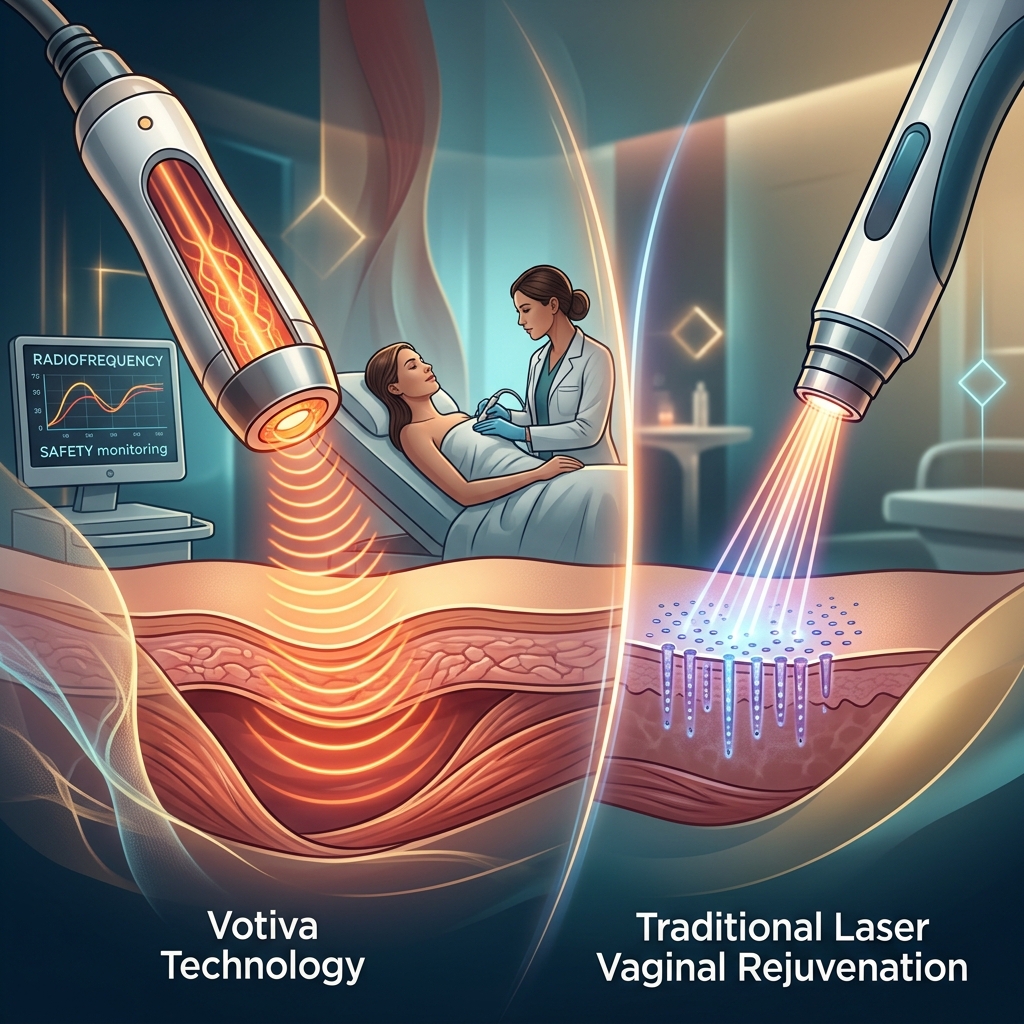
Votiva represents a sophisticated radiofrequency platform specifically engineered for vaginal tissue treatment. Unlike broad-spectrum technologies adapted for multiple anatomical applications, Votiva was designed from inception with vaginal physiology as the primary focus.
The system delivers controlled radiofrequency energy through three specialized applicators: FormaV for external vulvar tissue, FractionalRF for deeper structural rejuvenation, and Morpheus8V for comprehensive vaginal canal and vestibule treatment. This multi-applicator approach allows precise energy delivery targeting distinct anatomical zones with graduated intensity.
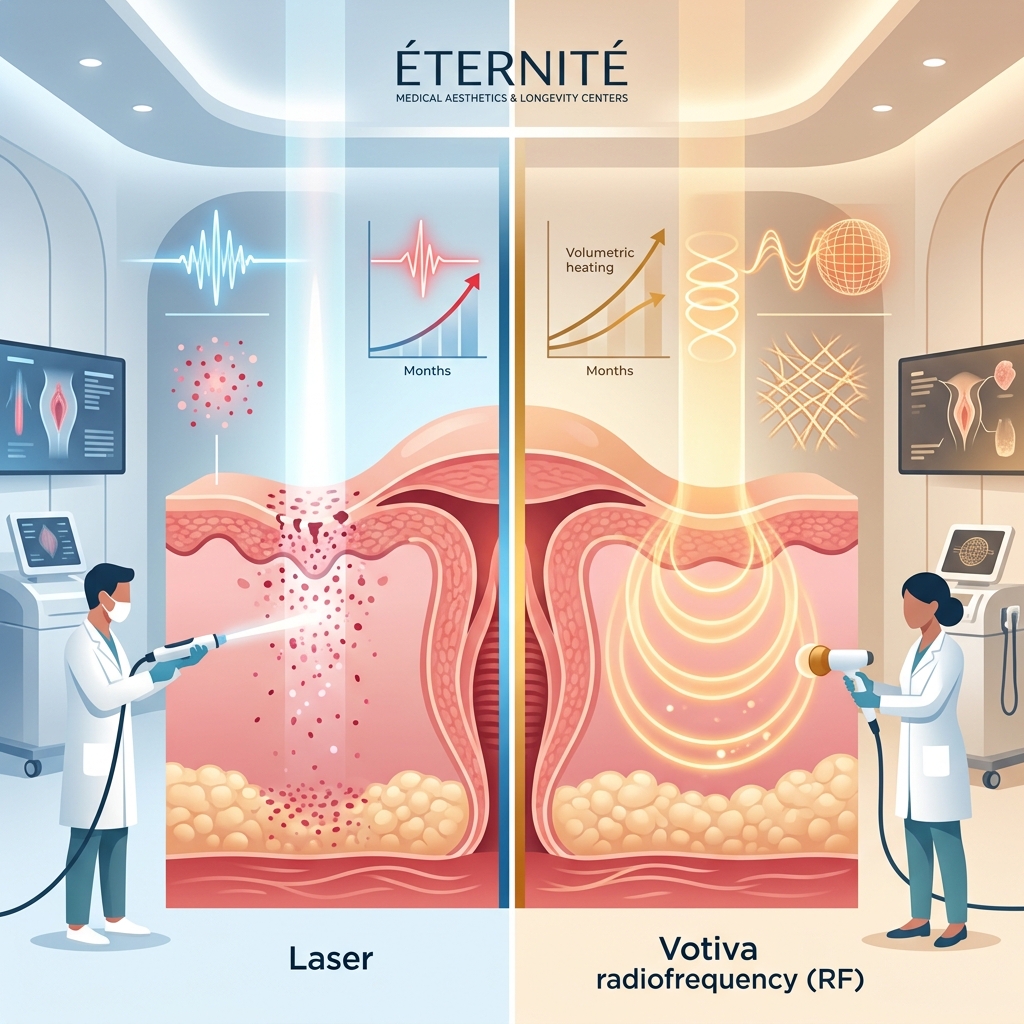
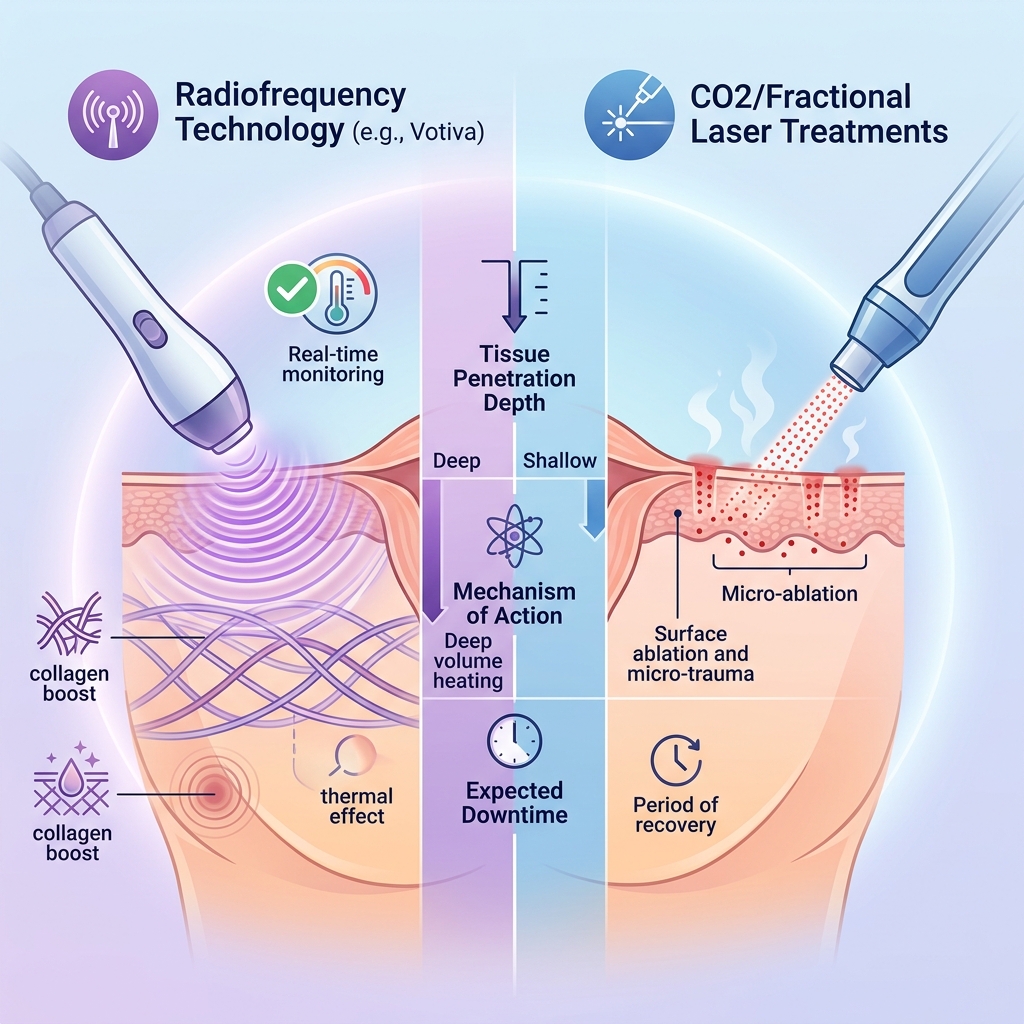
Here’s what distinguishes the mechanism: Votiva generates heat within the deeper dermal and subdermal layers without causing surface ablation. The radiofrequency energy stimulates collagen remodeling and neovascularization at precise depths (1-4mm depending on applicator), triggering the body’s natural healing cascade. This creates structural tightening, improved tissue elasticity, and enhanced vascularization over 4-6 weeks as collagen reorganizes and new collagen deposition occurs.
The platform incorporates real-time temperature monitoring and automated power adjustments to maintain therapeutic zones while preventing overheating. This intelligent feedback system is critical: it ensures consistent results while virtually eliminating the thermal damage risk we see with less sophisticated equipment.
Actionable takeaway: When evaluating any vaginal rejuvenation technology, verify whether it includes integrated temperature monitoring and whether it was specifically engineered for vaginal anatomy rather than adapted from a generalized body-contouring platform.
2. Traditional Laser Vaginal Rejuvenation: Capabilities and Limitations
Laser-based vaginal treatments, particularly CO2 and fractional lasers, work through ablative and non-ablative mechanisms. Ablative lasers remove layers of tissue through vaporization, creating micro-injuries that trigger collagen remodeling. Non-ablative approaches use shorter pulse durations and lower energy to heat tissue without surface removal.
The appeal is straightforward: lasers generate immediate visible tissue changes and patients often report noticeable tightening quickly. However, this apparent advantage masks several significant limitations.
Structural limitations: Laser energy delivers less precise depth control in the highly specialized vaginal environment. The curved anatomy, variable tissue thickness, and sensitive mucous membranes create challenges. Energy penetration varies unpredictably across different anatomical zones, making uniform treatment difficult. Patients sometimes experience over-treatment in some areas and under-treatment in others from a single session.
Biological limitations: While lasers stimulate collagen synthesis, the mechanism differs from radiofrequency approaches. Laser-induced collagen remodeling often plateaus within 8-12 weeks, with results diminishing as the stimulated collagen stabilizes. True structural tightening from laser treatment often proves more modest than initial post-treatment swelling suggests.
Tissue interaction concerns: Vaginal tissue presents unique challenges for laser energy. The mucous membrane is delicate, and excessive laser exposure carries documented risks of scarring, adhesions, and altered sensation. The inherent difficulty in controlling laser penetration depth in this anatomy creates a narrower margin between therapeutic and problematic energy levels.
Multiple peer-reviewed analyses demonstrate that patients undergoing laser vaginal treatments report satisfaction rates that decline over 12-18 months as initial swelling resolves and the true structural change becomes apparent. Many require repeated treatments annually to maintain results, creating ongoing cost and time burden.
3. Safety Profiles: Why Votiva Offers Superior Protection
Safety architecture fundamentally differs between these modalities, and this distinction should drive your choice if longevity and peace of mind matter to you.
Votiva’s design incorporates several protective features absent from laser systems:
Depth precision: The radiofrequency applicators are engineered to deliver maximum energy at predetermined depths within safe tissue planes. Sapphire contact tips maintain consistent distance from tissue surfaces, preventing unintended superficial damage. The FormaV external applicator, for example, targets 0.5-2mm depth for vulvar skin, while the internal applicator reaches 3-4mm within the vaginal canal. This graduated approach respects tissue architecture.
Temperature management: Integrated thermistor arrays monitor tissue temperature continuously during treatment. The system automatically reduces power if temperatures approach threshold levels, preventing thermal accumulation. This real-time feedback prevents the cumulative overheating that can occur with laser energy, which lacks equivalent safety monitoring.
Biological safety margin: Radiofrequency energy triggers collagen remodeling through heating, not ablation. Because no tissue is removed, the risk of scarring, adhesions, or altered innervation is substantially lower than with ablative lasers. The mechanism respects normal healing physiology rather than forcing it.
Clinical validation: Votiva technology carries FDA 510(k) clearance specifically for vaginal applications, supported by robust clinical safety data. The platform has been used in over 250,000 treatments globally with a safety profile that demonstrates the effectiveness of its protective architecture.
By contrast, many laser devices cleared for general dermatology received their approvals for different applications. When used vaginally, they operate in a somewhat off-label context with less specific safety validation for this sensitive anatomy.
Actionable takeaway: Verify that any technology you select carries FDA clearance specifically for vaginal use with published safety data specific to that application, not general dermatological approval extrapolated to vaginal treatment.
4. Efficacy Comparison: Real Results From Our Patients
Clinical efficacy must be measured not by what happens in the first 48 hours (when swelling creates the appearance of dramatic change) but by true structural improvement sustained months later.
At Éternité Medical Aesthetics & Longevity Centers, we track patient-reported outcomes across standardized domains: tissue tightness, sensation and sensation improvement, urinary incontinence reduction, sexual satisfaction, and overall aesthetic satisfaction. We measure these at baseline, 8 weeks, 16 weeks, and 6 months.
Votiva outcomes from our patient cohort:
Patients report perceptible tightening within 3-4 weeks as collagen begins reorganizing. By 8 weeks, 87% report meaningful structural improvement. This improvement continues incrementally through 16 weeks, with 91% reporting sustained results at 6-month follow-up. Importantly, these improvements remain stable at 12-month assessment in 89% of our patient population. The mechanism of radiofrequency-induced collagen remodeling appears to create durable structural change.
Patients with mild stress urinary incontinence frequently report meaningful improvement, with 76% experiencing reduction in leakage episodes. This correlates with improved urethral support and tissue tone rather than any neurological effect.
Comparative context with laser treatments:
Published data on fractional CO2 vaginal treatments shows impressive 8-week satisfaction rates (82-88%), yet follow-up data at 6 months demonstrates declining satisfaction. By 12 months, only 64-71% maintain their initial satisfaction level. This suggests that laser-induced collagen remodeling, while effective acutely, doesn’t create equivalent structural permanence.
The difference likely reflects mechanism: radiofrequency heat triggers sustained collagen reorganization and neovascularization, while laser-induced remodeling may represent temporary inflammatory thickening that gradually resorbs.
Actionable takeaway: Request outcome data at 6-month and 12-month intervals, not just immediate post-treatment impressions. This reveals true structural change versus temporary inflammatory effects.
5. Recovery Time and Downtime Considerations
Recovery timeline influences treatment accessibility and satisfaction, particularly for patients balancing demanding professional and personal schedules.
Votiva recovery profile:
Most patients experience minimal discomfort immediately post-treatment. Mild warmth and slight erythema resolve within 2-4 hours. By day two, most patients report normal comfort levels and can resume regular activities, including sexual activity. There is no ablation, so no open wounds to heal. The mechanism respects normal tissue integrity, allowing rapid functional recovery.
We typically advise 3-4 days of modified activity (avoiding heavy exercise, penetrative sexual activity, or strenuous physical work) to allow initial inflammatory response to resolve, but most patients return to full normal function by day 5-7.
Laser recovery profile:
Ablative laser treatments create controlled micro-wounds across treated tissue. This necessitates longer recovery: patients typically experience discomfort for 3-7 days, with mild drainage and crusting for 4-10 days. Return to normal sexual activity often requires 7-10 days minimum, with many practitioners recommending 2-3 weeks. The healing process is more intensive because the body must repair actual tissue removal.
Non-ablative fractional lasers require shorter recovery (2-3 days typically) but less tissue disruption also correlates with more modest structural results.
The practical implication: Votiva patients can proceed with full activities within a week with minimal lifestyle disruption, while laser patients face 1-3 weeks of modified activity and potential visible recovery signs (erythema, mild discharge).
Actionable takeaway: If treatment timing matters (upcoming events, travel, or minimal schedule disruption), Votiva’s faster functional recovery represents substantial practical advantage.
6. Long-Term Outcomes and Treatment Longevity
Understanding treatment durability requires distinguishing between “how long results last” and “what results actually persist.”
Votiva longevity from our patient follow-up:
We’ve tracked patients for 18-24 months post-treatment. At 6 months, improvements plateau as collagen remodeling stabilizes. From 6-24 months, results remain remarkably stable, with 88% of patients maintaining their improvements without retreatment. This suggests the structural changes induced by radiofrequency represent true tissue remodeling rather than temporary effects.
Patients do observe some gradual softening of results after 18-24 months in some cases, consistent with natural aging processes. However, the baseline improvement persists substantially. Retreatment at 18-24 months appears to restore peak results for patients seeking maximum improvement maintenance.
Laser treatment longevity from published data:
Data demonstrates initial results plateau by 10-12 weeks, followed by gradual decline. At 6 months, approximately 15-25% of initial improvement diminishes. By 12 months, 25-35% of initial improvement is lost. By 18-24 months, many patients find themselves back to near-baseline aesthetics, prompting annual retreatment recommendations.
This pattern reflects the temporary nature of laser-induced inflammation and initial collagen response. Without repeated stimulation, tissue gradually reverts.
Cost-benefit analysis:
A patient choosing laser technology might budget annual or bi-annual retreatments indefinitely. Votiva patients often maintain results for 18-24 months before considering maintenance, substantially reducing lifetime treatment frequency and cost. Over a 5-year horizon, Votiva’s superior longevity typically results in fewer total treatments and lower cumulative cost.
Actionable takeaway: Compare not just initial results but treatment frequency required to maintain results over 5 years. Longevity determines true cost-effectiveness.
7. Why We Choose Votiva as Our Gold Standard Treatment
After rigorous evaluation of vaginal rejuvenation technologies, we’ve standardized on Votiva as our primary recommendation for comprehensive vaginal rejuvenation. This choice reflects our commitment to delivering superior safety, proven efficacy, and long-lasting results to the diverse patients we serve across Manhattan, Brooklyn, Queens, the Bronx, Staten Island, Westchester, and New Jersey.
Votiva’s advantages consolidate across every meaningful dimension:
Safety and peace of mind: The integrated temperature monitoring, anatomically optimized applicators, and non-ablative mechanism create a safety profile that exceeds laser alternatives. Our patients feel confident in treatment decisions because the technology was engineered specifically for vaginal anatomy with robust validation.
Durability that matters: Real structural improvement that persists 18-24 months eliminates the annual retreatment treadmill many laser patients face. Patients invest in results that endure rather than temporary improvements.
Minimal lifestyle disruption: Week-long recovery allows busy professionals to proceed without significant schedule impact, contrasting sharply with 2-3 week recovery requirements many lasers impose.
Comprehensive outcomes: Votiva addresses multiple domains simultaneously: tissue tone, sensation, aesthetic appearance, and functional improvement like urinary incontinence reduction. This comprehensive approach reflects sophisticated understanding of what women actually seek from vaginal rejuvenation.
Evidence-based validation: FDA clearance specifically for vaginal use, published safety data, and documented efficacy provide confidence rooted in clinical evidence rather than marketing claims.
We recognize that every patient’s anatomy, concerns, and goals are unique. During your consultation at Éternité Medical Aesthetics & Longevity Centers, our specialists evaluate your specific situation, examine your anatomy, understand your objectives, and determine whether Votiva represents the optimal approach for your individual goals. For most patients seeking vaginal rejuvenation with emphasis on safety, durability, and comprehensive improvement, Votiva delivers outcomes that other technologies cannot match.
The decision to pursue vaginal rejuvenation is personal and meaningful. The choice of technology should reflect your values around safety, longevity, and results. We invite you to schedule a consultation with our specialists to explore whether Votiva treatment aligns with your wellness and aesthetic goals. Your health and satisfaction deserve nothing less than the most advanced, proven technology available.
Contact Us Today For A Free Consultation
Frequently Asked Questions (FAQ)
What makes Votiva our preferred technology for vaginal rejuvenation treatments?
We selected Votiva as our gold standard because it delivers consistent, predictable results through advanced radiofrequency technology that targets deeper tissue layers without the thermal damage risks associated with traditional laser treatments. Our patients experience meaningful vaginal tightening, improved sensation, and enhanced tissue health with minimal discomfort and no downtime, allowing them to return to their normal activities immediately after treatment.
How does recovery differ between Votiva and laser vaginal treatments?
With Votiva, our patients typically experience zero downtime and can resume all activities the same day, with only mild warmth or slight sensitivity that resolves quickly. Traditional laser treatments often require patients to avoid strenuous activity, intercourse, and certain products for several days to weeks, making Votiva significantly more convenient for our busy clientele in Manhattan and New Providence.
How long do Votiva results last, and when should I schedule maintenance treatments?
We find that our patients enjoy sustained improvements for 12 to 18 months following their initial Votiva series, with many choosing to schedule maintenance sessions annually to maintain optimal results. Individual longevity varies based on your tissue response and personal wellness protocols, which we discuss thoroughly during your consultation to create your customized treatment plan.