


Table of Contents
- The Search for Real Collagen Solutions: Why Standard Treatments Fall Short
- Understanding Exosomes: How Cellular Communication Rebuilds Your Skin
- PDRN Microneedling Explained: Polynucleotides Meet Micro-Injury Technology
- Collagen Production: Which Method Activates Deeper Regeneration
- Skin Texture and Elasticity: Real Results From Each Approach
- Recovery Time and Downtime: What to Expect With Each Treatment
- Longevity of Results: Which Treatment Lasts Longer
- Combining Exosomes and PDRN: Our Advanced Layering Protocol
- Personalized Assessment: How We Determine Your Ideal Treatment
- Why Éternité Leads in Regenerative Skin Science
- Investment in Your Skin: Understanding Treatment Pricing and Value
- Begin Your Skin Transformation Today
- Frequently Asked Questions (FAQ)
The Search for Real Collagen Solutions: Why Standard Treatments Fall Short
The aesthetic landscape has shifted dramatically. Surface-level treatments like basic facials and topical creams no longer satisfy those seeking genuine skin transformation. Patients come to us asking the same question: “Why don’t standard procedures deliver lasting collagen rebuilding?”
The answer lies in mechanism. Most conventional treatments trigger only superficial collagen stimulation. They create inflammation without orchestrating the deeper cellular signaling that drives true regeneration. Serums and peels address the stratum corneum but fail to reprogram fibroblast behavior at the dermal level. Injectable fillers add volume temporarily but don’t activate your skin’s own manufacturing capacity.
This is where advanced regenerative treatments diverge from conventional aesthetics. At Éternité Medical Aesthetics & Longevity Centers, we recognize that authentic skin rejuvenation requires triggering your body’s intrinsic healing intelligence. Two technologies have emerged as leaders in this space: exosomes and PDRN (Polydeoxyribonucleotide) microneedling. Understanding their distinct mechanisms helps you choose the approach that aligns with your skin’s specific needs.
What to do next: Schedule a consultation to assess whether your skin requires targeted cellular communication enhancement (exosomes) or micro-injury collagen activation (PDRN microneedling).
Understanding Exosomes: How Cellular Communication Rebuilds Your Skin
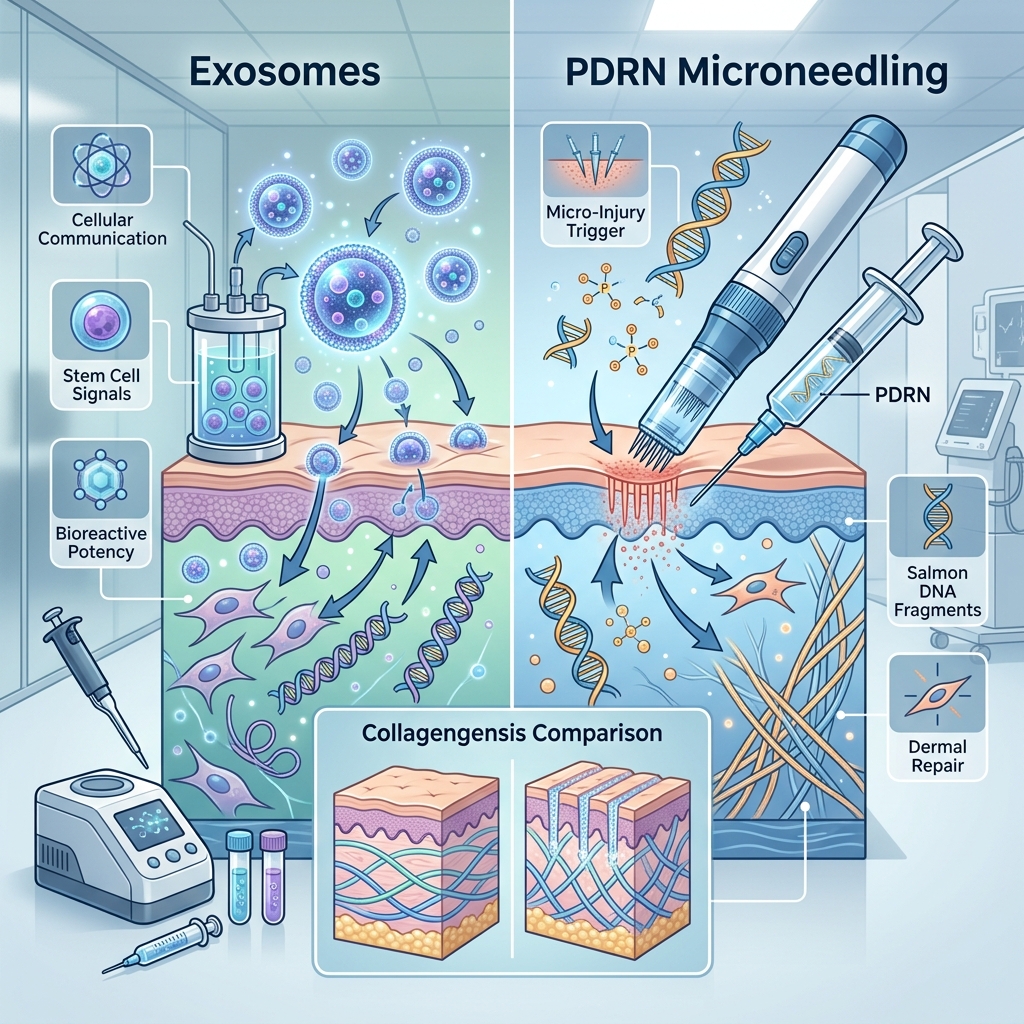
Exosomes are precisely engineered extracellular vesicles derived from mesenchymal stem cells. Think of them as microscopic information carriers. Each exosome measures 30-150 nanometers and contains growth factors, cytokines, microRNAs, and proteins that communicate directly with your skin cells.
When we apply exosomes to your skin, they penetrate the dermal layer and dock with fibroblasts and other cellular receptors. This interaction essentially reprograms your cells’ behavior without adding foreign material. The exosomes deliver instructions that:
- Activate fibroblast proliferation and collagen synthesis
- Reduce inflammatory markers that accelerate collagen breakdown
- Enhance cellular turnover and tissue repair mechanisms
- Stimulate angiogenesis (new blood vessel formation) for improved skin nutrition
The beauty of exosome therapy lies in its non-invasive application combined with profound biological activity. We can deliver exosomes topically, transdermally, or via microneedling channels. Unlike growth factors that degrade rapidly, exosomes protect their payload and sustain cellular signaling for weeks after treatment.
Clinical outcomes demonstrate improvements in skin firmness, radiance, and fine line reduction within 4-6 weeks, with continued refinement over 12 weeks. Exosomes work particularly well for those seeking comprehensive rejuvenation without aggressive intervention.
PDRN Microneedling Explained: Polynucleotides Meet Micro-Injury Technology
PDRN represents a distinct approach: polynucleotides extracted from salmon DNA combined with controlled micro-injury. When we perform PDRN microneedling, we’re employing two simultaneous mechanisms.
First, the microneedling device creates precise microchannels in the dermis, triggering your body’s wound-healing cascade. This controlled injury activates fibroblasts and initiates collagen deposition as your skin perceives the need to repair itself. Second, PDRN is deposited directly into these channels. The polynucleotides act as biocompatible scaffolds and signaling molecules that amplify the healing response.
PDRN’s molecular structure mirrors DNA, which your cells recognize as authentic biological information. This compatibility allows PDRN to:
- Enhance fibroblast recruitment and activation
- Accelerate new collagen and elastin synthesis
- Improve microcirculation and tissue oxygenation
- Reduce post-inflammatory hyperpigmentation risk
The combination of mechanical stimulation plus chemical signaling creates a powerful regenerative environment. Your skin responds by manufacturing new structural proteins rather than simply receiving external signals. This approach delivers visible texture refinement and firmness gains often within 2-3 weeks, with optimal results at 8-12 weeks.
Collagen Production: Which Method Activates Deeper Regeneration
Both therapies stimulate collagen, but through different pathways. Understanding these distinctions helps clarify which may serve you better.
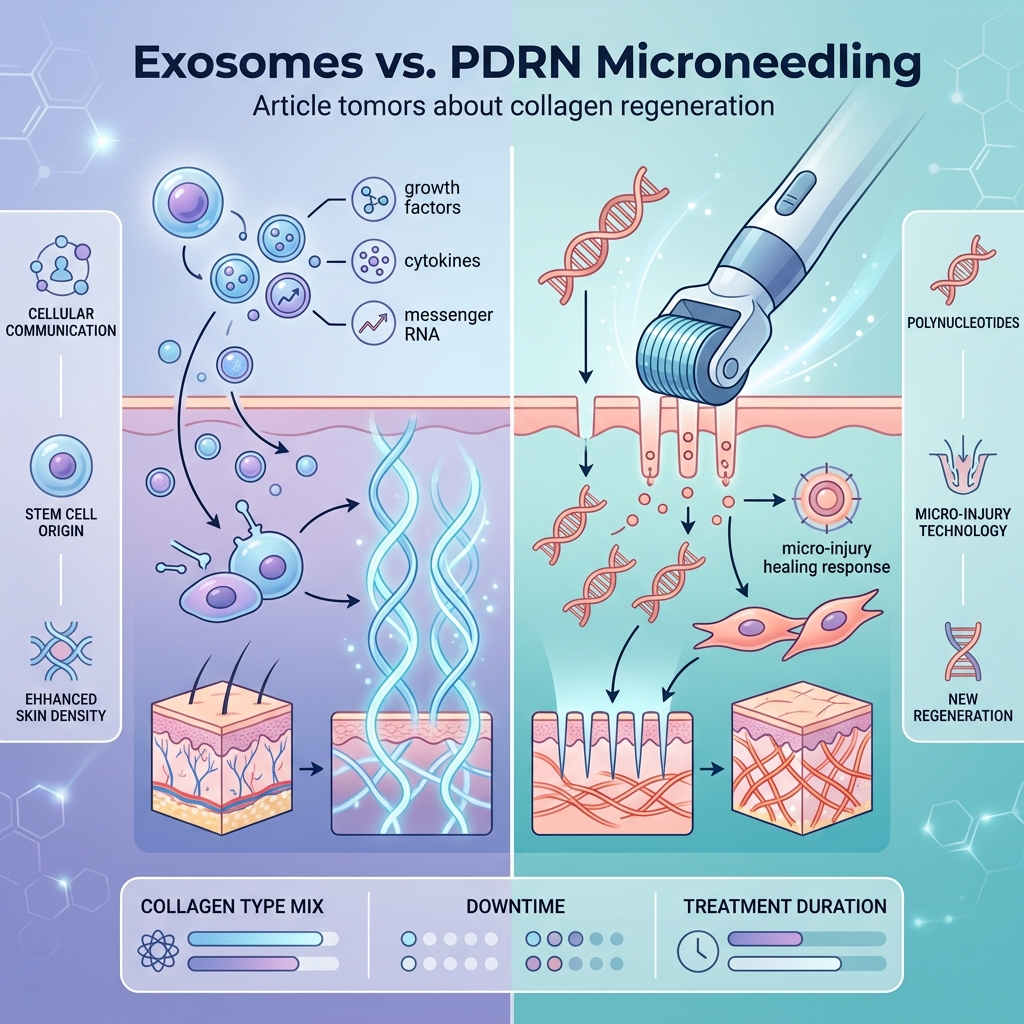
Exosome therapy operates through paracrine signaling. The exosomes instruct your fibroblasts to increase collagen production without disrupting the skin barrier. This results in sustained, steady collagen synthesis over an extended period. The cellular reprogramming effect means collagen production can remain elevated for months after a single treatment series.
PDRN microneedling creates an acute regenerative window. The microneedling injury induces immediate fibroblast activity and growth factor release. PDRN then sustains and amplifies this response. This approach generates rapid collagen deposition but typically requires a series of treatments (usually 3-4) spaced 4-6 weeks apart to achieve cumulative results.
Clinical studies show exosomes may achieve slightly higher absolute collagen density in the deep dermis, while PDRN delivers more visible surface texture refinement due to the mechanical component. For those seeking maximum collagen rebuilding depth, exosomes excel. For those prioritizing noticeable texture smoothing and firmness in a shorter timeframe, PDRN microneedling often outperforms.
Real example: A 48-year-old patient with loss of cheek volume and skin laxity received exosome therapy monthly for three months. Ultrasound imaging showed 23% increase in dermal thickness. Conversely, a 52-year-old with significant surface roughness and enlarged pores completed four PDRN microneedling sessions quarterly, achieving dramatic pore refinement and visible skin smoothness within 8 weeks.
Skin Texture and Elasticity: Real Results From Each Approach
Texture transformation represents one of the most satisfying outcomes our patients experience. Both treatments excel here, yet with subtle differences.
Exosome therapy refines texture gradually and comprehensively. Patients report softer, more luminous skin with improved hydration and a refined appearance. The treatment minimizes pore visibility through collagen remodeling and doesn’t create active inflammation, so results emerge without obvious post-treatment signs. Elasticity improvements become apparent around week 3-4 as new collagen integrates into existing tissue architecture.
PDRN microneedling delivers faster, more dramatic texture changes. The immediate post-treatment inflammatory response triggers rapid healing and collagen remodeling. Pore size decreases noticeably, fine lines soften visibly, and skin firmness improves within the first 2-3 weeks. Elasticity gains feel more pronounced because the mechanical component activates existing elastin fibers simultaneously with new synthesis.
For elasticity specifically, both treatments strengthen dermal-epidermal junction integrity. Exosomes work through sustained cellular signaling, while PDRN’s mechanical component plus polynucleotides create more aggressive remodeling. Patients seeking subtle, natural progression favor exosomes. Those wanting faster, more visible transformation choose PDRN microneedling.
Recovery Time and Downtime: What to Expect With Each Treatment
Downtime considerations matter significantly in cosmetic treatment selection. Here’s the realistic breakdown.
Exosome therapy is the no-downtime option. We apply exosomes topically or via gentle delivery methods that don’t disrupt your skin barrier. You may experience mild redness lasting 2-4 hours, but most patients return to regular activities immediately. Makeup application is fine within hours. There’s no post-treatment sensitivity, peeling, or flaking. This makes exosome therapy ideal for those with demanding schedules or events within days of treatment.
PDRN microneedling requires consideration for downtime. The procedure creates visible redness and mild swelling lasting 24-48 hours. Most patients experience light flaking or peeling between days 3-7. We recommend scheduling treatments when you can minimize sun exposure and strenuous activity for 48 hours. Many patients apply makeup after 24 hours once inflammation subsides. The trade-off is acceptable downtime for faster, more dramatic results.
From a practical standpoint, exosomes suit those valuing convenience and seamless integration into daily life. PDRN microneedling suits those willing to accept brief downtime for accelerated transformation. Neither approach requires extensive recovery compared to surgical alternatives.
Longevity of Results: Which Treatment Lasts Longer
Treatment longevity is a legitimate investment consideration. How long do results persist after completion?
Exosome therapy delivers remarkably durable results. Because we’re reprogramming cellular behavior at the genetic expression level, the benefits compound. After an initial series (typically 3-4 sessions monthly), patients maintain visible improvements for 8-12 months with appropriate skincare and sun protection. The collagen your fibroblasts generate during exosome therapy integrates into your dermis and functions as permanent structural support. Many patients return for annual maintenance treatments rather than requiring frequent touch-ups.
PDRN microneedling results follow a different trajectory. The collagen deposition from treatment is substantial, but without additional treatments, results gradually soften over 6-9 months as natural collagen remodeling occurs. However, completing the full treatment series creates a cumulative effect where new collagen persists longer than isolated sessions. Optimal outcomes emerge 3-4 months post-series and remain visible for 8-10 months, after which a maintenance session is advisable.
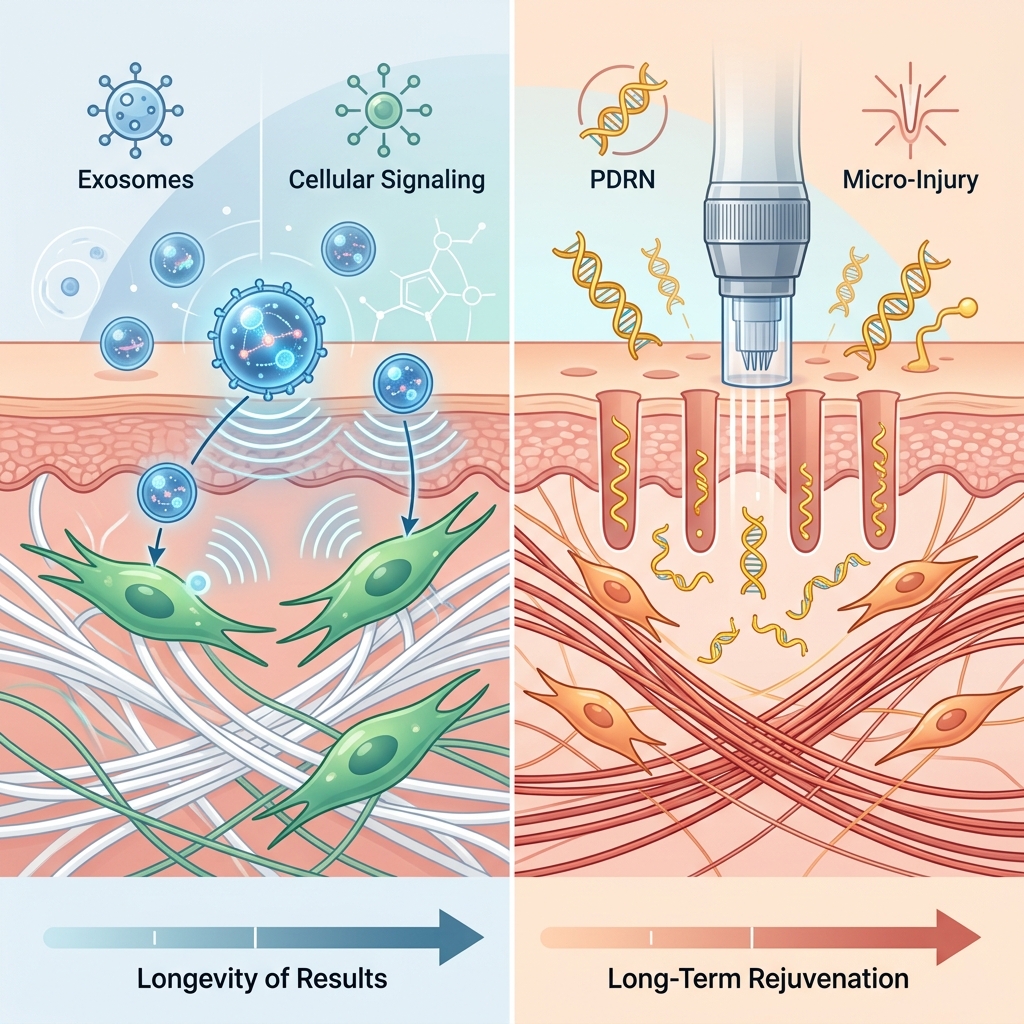
The practical difference: Exosome therapy patients typically schedule one maintenance treatment annually. PDRN microneedling patients often benefit from maintenance sessions every 9-12 months or a single refresher session to sustain peak results. Both represent excellent long-term value compared to injectable fillers requiring replacement every 6-12 months.
Combining Exosomes and PDRN: Our Advanced Layering Protocol
At Éternité Medical Aesthetics & Longevity Centers, we’ve developed sophisticated protocols that combine both technologies for superior outcomes. Layering these approaches amplifies regenerative signaling in ways neither delivers alone.
Our advanced protocol typically sequences treatments as follows:
Phase One: PDRN microneedling establishes the regenerative foundation. The mechanical injury activates your fibroblasts and creates receptivity for subsequent cellular signaling. We perform 3-4 sessions spaced 4-6 weeks apart.
Phase Two: Exosome therapy follows, typically beginning 2-3 weeks after the final PDRN session. By this point, initial collagen synthesis is underway and fibroblasts are primed. Exosomes then amplify and sustain this collagen production. We deliver 2-3 exosome sessions at monthly intervals.
Result: Combined therapy achieves collagen density and skin quality improvements exceeding either treatment alone. Patients report faster texture refinement, more dramatic firmness gains, and longer-lasting results extending 12-18 months.
The mechanism is synergistic. PDRN creates the cellular activation and initial collagen response. Exosomes sustain and amplify that response while addressing concurrent skin concerns like hydration and radiance. This combination is particularly effective for patients with significant skin aging, texture damage, or those seeking comprehensive facial rejuvenation.
Personalized Assessment: How We Determine Your Ideal Treatment
Treatment selection begins with precise assessment. We evaluate multiple factors before recommending exosomes, PDRN microneedling, or combination therapy.
Our clinical evaluation considers:
- Skin thickness and elasticity (assessed via ultrasound when appropriate)
- Primary aging concerns (texture vs. laxity vs. volume loss)
- Collagen loss severity and distribution
- Skin sensitivity and inflammatory tendency
- Patient timeline and downtime tolerance
- Budget and long-term commitment capacity
A patient with early aging signs and excellent skin health may benefit most from preventative exosome therapy. Someone with significant texture damage and loose skin might require PDRN microneedling for dramatic improvement. A patient with 10+ years of sun damage and cumulative aging changes often achieves optimal results through our combination protocol.
During consultation, our clinical team performs detailed assessment and discusses your specific goals. We explain precisely how each approach addresses your skin’s unique needs. This personalized approach ensures you receive treatments aligned with your concerns rather than a standardized protocol applied uniformly.
Why Éternité Leads in Regenerative Skin Science
Our distinction in regenerative aesthetics stems from several commitments. First, we invest exclusively in clinical-grade technologies. Our exosomes derive from rigorously vetted sources with proven efficacy data. Our PDRN formulations meet pharmaceutical-grade specifications and undergo rigorous quality control.
Second, our providers combine deep aesthetic expertise with regenerative medicine training. Treatment delivery matters immensely. Precise microneedling depth, appropriate exosome dosing, and proper layering protocols separate exceptional results from mediocre outcomes. Our team possesses the clinical sophistication to execute these nuanced treatments correctly.
Third, we maintain comprehensive outcome tracking. We photograph patients systematically, perform objective skin analysis, and maintain long-term follow-up data. This commitment to measurable results ensures continuous refinement of our protocols and honest assessment of what each treatment delivers.
Finally, we view regenerative skin science through a longevity lens. These treatments represent investment in your skin’s long-term health and function, not merely temporary aesthetic improvement. We design treatment protocols to build lasting collagen architecture and sustained cellular vitality.
Investment in Your Skin: Understanding Treatment Pricing and Value
Regenerative treatments represent significant investment, and understanding value helps contextualize pricing.
Exosome therapy typically ranges from $800-1,500 per session for facial application, with most patients completing 3-4 sessions for optimal initial results. Total initial investment ranges $2,400-6,000. Annual maintenance adds $800-1,500 per session. Over five years, comprehensive exosome therapy costs approximately $7,000-12,000 for sustained superior skin quality.
PDRN microneedling generally costs $600-1,200 per session, with most protocols requiring 3-4 initial sessions. Initial investment totals $1,800-4,800. Maintenance sessions every 9-12 months add $600-1,200 annually. Five-year cost approximately $4,500-10,000.
Combined protocols (PDRN plus exosomes) represent higher initial investment but deliver superior results and longer durability. Initial protocol cost ranges $4,500-10,000 over 4-5 months, with annual maintenance $1,500-2,000. Five-year investment approximately $12,000-18,000.
Comparative perspective: Traditional dermal fillers cost $600-800 per syringe with 6-12 month duration, requiring $1,200-3,200 annually. Over five years, filler maintenance costs $6,000-16,000 with no improvement to your skin’s actual structure. Our regenerative protocols cost similarly or less while building permanent collagen architecture.
We offer tiered wellness memberships and flexible treatment scheduling to make advanced regenerative care accessible. During consultation, we discuss investment options aligned with your budget and aesthetic goals.
Begin Your Skin Transformation Today
The difference between exosomes and PDRN microneedling represents the evolution of aesthetic medicine from temporary solutions toward genuine regeneration. Both technologies activate your skin’s intrinsic capacity to rebuild collagen, refine texture, and restore youthful vitality.
Your next step is straightforward: contact Éternité Medical Aesthetics & Longevity Centers to schedule a comprehensive skin assessment. Our clinical team will evaluate your specific concerns, explain how each approach addresses your needs, and design a personalized treatment protocol. Whether you’re in Manhattan, Brooklyn, the Bronx, Westchester, or the New Jersey area, we’re prepared to guide your skin transformation.
Advanced regenerative aesthetics isn’t luxury for the few. It’s an accessible investment in your skin’s long-term health and appearance. Let us help you discover which proven technology unlocks your skin’s greatest potential.
For further reading: Morpheus8 body microneedling, HydraFacial treatment.
Contact Us Today For A Free Consultation
Frequently Asked Questions (FAQ)
What’s the main difference between exosomes and PDRN microneedling for collagen regeneration?
Exosomes work by delivering cellular communication signals that instruct your skin cells to produce more collagen naturally, while PDRN microneedling combines micro-injuries with polynucleotides to trigger your body’s healing response. We’ve found that exosomes operate at the cellular messaging level, whereas PDRN relies on the injury-repair pathway. Each method has distinct advantages depending on your skin’s specific needs and regenerative capacity.
Can we combine exosomes and PDRN together, or do we need to choose one?
We actually offer our Advanced Layering Protocol, which strategically combines both treatments to maximize collagen induction and skin regeneration. By layering these approaches, we can target multiple regenerative pathways simultaneously, which often produces superior results compared to either treatment alone. During your personalized assessment, we’ll determine whether your skin would benefit most from layering, sequential treatments, or a single modality.
How long do results last with each treatment, and how often do we recommend retreatment?
Exosome results typically build progressively over several weeks and can maintain improvements for four to six months, while PDRN microneedling often shows sustained benefits for three to five months before gradual fading occurs. We typically recommend maintenance sessions based on your individual healing response and aesthetic goals, which we’ll discuss during your consultation. Our longevity protocols are customized to help you achieve lasting results without excessive downtime.