


Table of Contents
- Why Dark Skin Requires Specialized Laser Technology
- The Risks of Standard Laser Hair Removal on Melanated Skin
- How We Select Safe Wavelengths for Your Skin Type
- Our Advanced Laser Systems for Dark Skin Hair Removal
- What to Expect During Your Consultation and Treatment
- Results and Maintenance: Long-Term Hair Reduction
- Why Our Manhattan and New Providence Centers Excel at Dark Skin Treatment
- Addressing Common Concerns About Laser Safety
- The Science Behind Effective Treatment for All Skin Tones
- Frequently Asked Questions (FAQ)
Why Dark Skin Requires Specialized Laser Technology
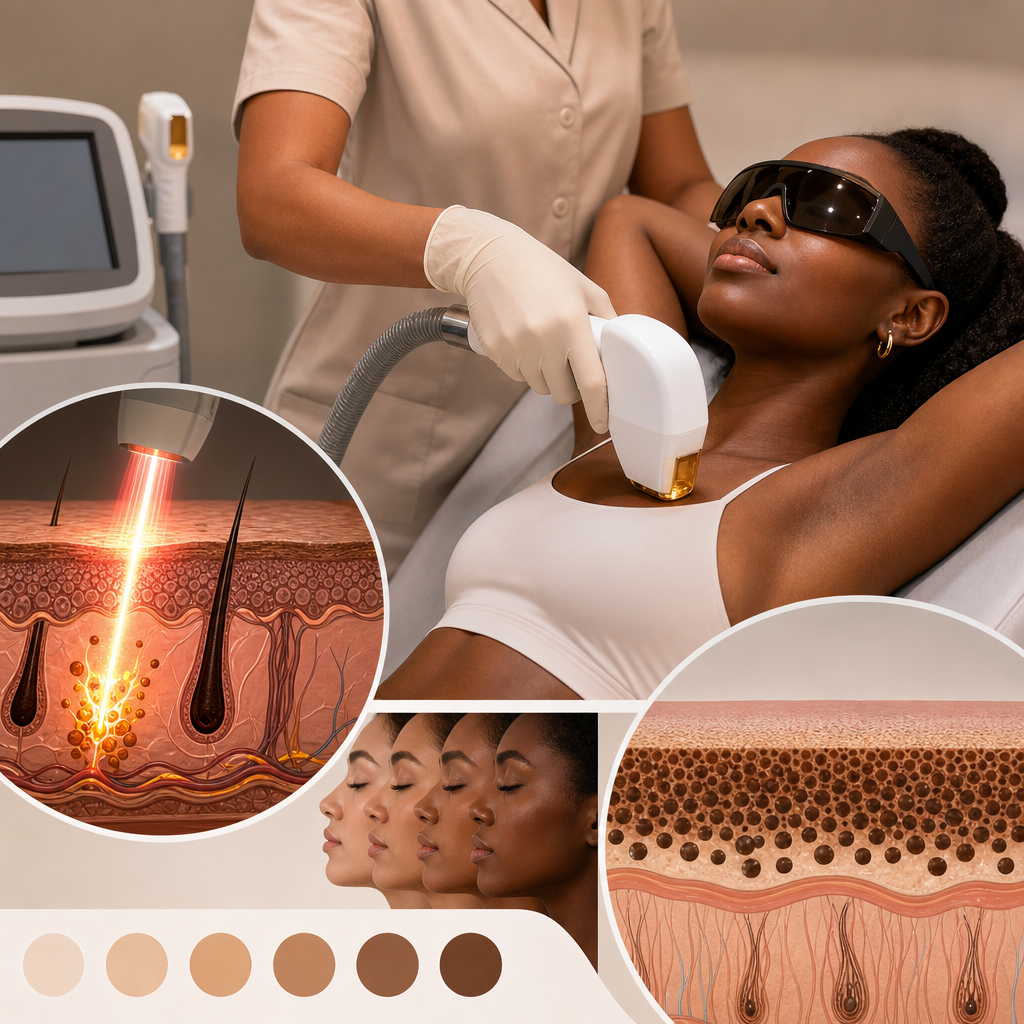
Darker skin types contain significantly higher concentrations of melanin, the pigment responsible for skin color. While melanin protects the skin from UV damage, it also absorbs laser energy intensely. This fundamental difference means that standard laser systems designed for lighter skin tones can pose serious safety risks when used on melanated skin.
At Éternité Medical Aesthetics & Longevity Centers, we recognize that safe and effective laser hair removal for darker skin requires precision engineering and deep clinical expertise. The challenge lies in targeting the melanin in hair follicles while minimizing energy absorption by the surrounding skin. This demands longer wavelengths, adjusted parameters, and technology specifically calibrated for your unique skin composition.
When providers use inappropriate laser systems on dark skin, they inadvertently treat the skin itself rather than the hair follicle selectively. The result: burns, hyperpigmentation, hypopigmentation, or scarring. That’s why we’ve invested in technology that delivers results without compromise to safety or efficacy.
Action step: Schedule a consultation with our specialists to assess your specific skin type and discuss which laser wavelengths are optimal for your needs.
The Risks of Standard Laser Hair Removal on Melanated Skin
Inadequate laser selection remains one of the leading causes of adverse outcomes in hair removal for darker skin types. Many facilities operate with systems designed during an era when the dermatological community had limited understanding of how different wavelengths interact with melanin-rich skin.
The primary risks include:
- Thermal burns: Rapid melanin absorption causes excessive heat buildup in the epidermis and dermis, leading to visible burns or post-inflammatory hyperpigmentation.
- Hyperpigmentation: Darkening of the treated area that can persist for weeks or months, sometimes permanently.
- Hypopigmentation: Loss of pigmentation in treated zones, creating pale patches that contrast sharply with surrounding skin.
- Textural changes: Burns can compromise the skin barrier, causing rough patches or scarring.
- Ineffective hair removal: Paradoxically, inappropriate wavelengths sometimes stimulate rather than eliminate hair growth (paradoxical hypertrichosis).
These complications underscore why choosing a medical facility with sophisticated technology and clinician experience is non-negotiable. We’ve invested in systems that eliminate these risks by operating at wavelengths that pass through melanin in the epidermis while efficiently targeting the darker melanin within the hair follicle itself.
Action step: Avoid facilities that claim their standard lasers work equally well on all skin types. Request specifics about wavelength, pulse duration, and cooling mechanisms.
How We Select Safe Wavelengths for Your Skin Type
Our approach begins with a thorough skin assessment using the Fitzpatrick scale, which classifies skin types I through VI based on melanin content and sun sensitivity. However, we go further. We examine your specific hair color, hair density, baseline skin tone, and any history of sensitivity or previous adverse reactions.
Different wavelengths behave differently:
- 810 nm (diode lasers): Excellent penetration and melanin specificity; our preferred choice for most darker skin types.
- 1064 nm (Nd:YAG lasers): Longer wavelength that penetrates deeper while minimizing superficial melanin absorption; ideal for very dark or deeply pigmented skin.
- Shorter wavelengths (like 755 nm alexandrite): Generally avoided on dark skin due to higher superficial melanin absorption.
Our clinicians evaluate your hair follicle depth, which varies by ethnicity and body area. Coarser, deeper follicles common in darker skin types require adequate penetration without excess surface energy. We also factor in your pain tolerance, desired timeline, and any aesthetic concerns specific to your goals.
The wavelength selection is just one variable. Pulse duration, fluence (energy density), and cooling technology work in concert. Extended pulse durations distribute heat more evenly, while integrated cooling systems protect the epidermis during treatment. This combination creates the safety margin that makes dark skin treatment genuinely comfortable and predictable.
Action step: During your consultation, ask our providers which specific wavelength they’re recommending and why it’s suited to your exact skin characteristics.
Our Advanced Laser Systems for Dark Skin Hair Removal
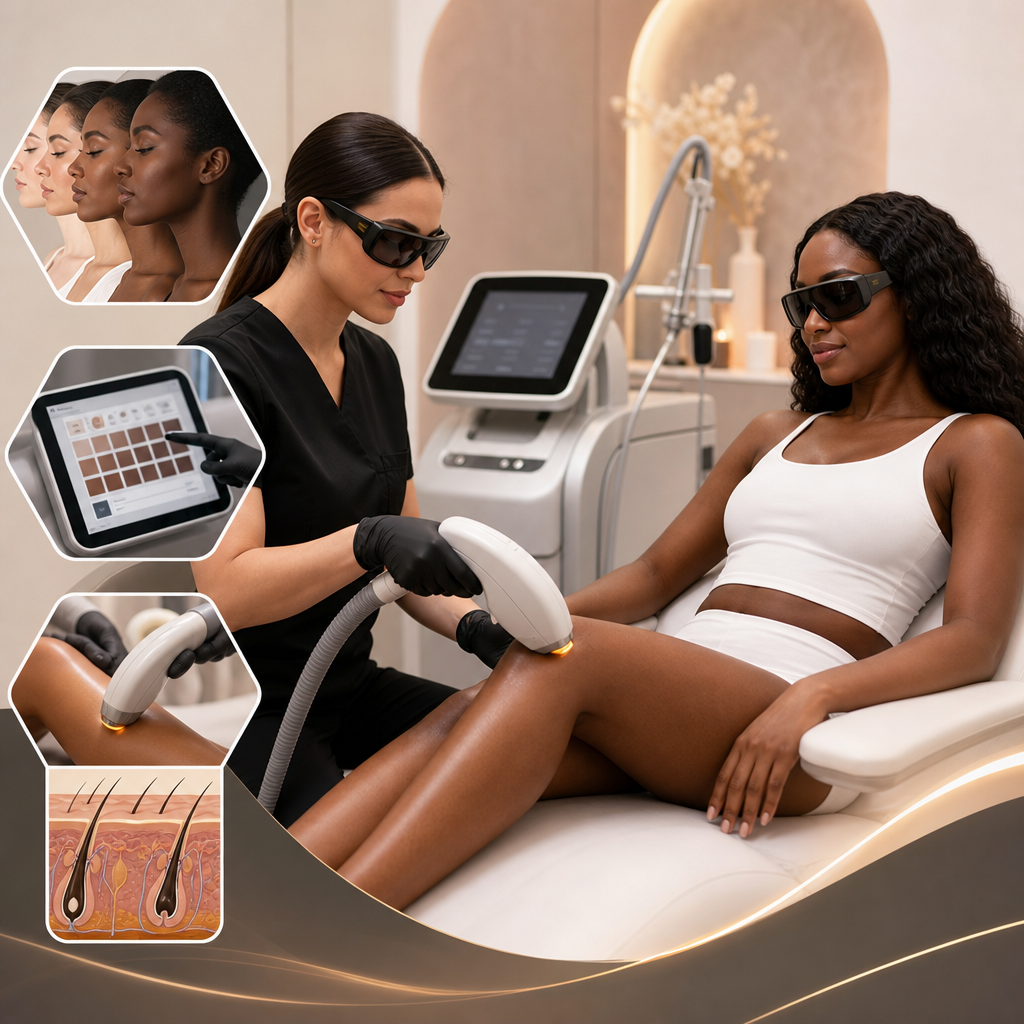
Éternité Medical Aesthetics & Longevity Centers operates cutting-edge systems specifically engineered for melanated skin. Our technology includes diode and Nd:YAG laser platforms with real-time skin cooling, dynamic settings adjustment, and integrated safety protocols that monitor skin response during each pass.
These systems feature:
- Intelligent cooling: Contact and/or cryogenic cooling that protects the epidermis while allowing therapeutic energy to reach the hair follicle.
- Customizable parameters: Pulse width, fluence, and frequency adjustments tailored to your skin type and hair characteristics in real time.
- Multi-wavelength capability: Access to both 810 nm and 1064 nm technology allows our clinicians to optimize for your specific needs rather than forcing one-size-fits-all treatment.
- Real-time feedback sensors: Technology that monitors skin temperature and reflectance, automatically adjusting settings if responses indicate risk.
Our clinicians spend time calibrating settings for your unique presentation. This isn’t a rushed appointment where everyone receives identical treatment parameters. We understand that safe, effective laser hair removal on dark skin requires individualized precision.
Action step: Ask your provider to walk you through the technology and explain which settings they’re using and why they chose them specifically for you.
What to Expect During Your Consultation and Treatment
Your first appointment at Éternité Medical Aesthetics & Longevity Centers begins with a comprehensive medical history and skin assessment. We discuss your goals, previous treatments, any sensitivities, medications, and recent sun exposure. Our providers examine your skin under magnification to assess melanin distribution, hair follicle characteristics, and baseline condition.
During this consultation, we explain the treatment protocol in detail: expected sessions (typically 6-8 for meaningful permanent reduction), interval spacing (usually 4-6 weeks), and realistic outcomes for your skin type. We test a small area with your chosen wavelength and settings, then observe your skin’s response over 24-48 hours before proceeding with full-area treatment.
On treatment days, the process follows this sequence:
- Cleanse the treatment area and apply cooling gel or contact cooling.
- Perform patch test if first session.
- Administer laser pulses methodically across the target area.
- Apply soothing post-treatment serum and broad-spectrum SPF 50+.
- Provide written aftercare instructions specific to your skin.
Most patients report minimal discomfort, describing sensation as a quick warm snapping feeling. The entire session typically takes 15-60 minutes depending on area size. Afterward, the treated area may appear slightly red or swollen; this resolves within hours to days.
Action step: Arrive at your appointment with clean, shaved skin (not waxed or plucked). Avoid sun exposure for at least two weeks before and after each session.
Results and Maintenance: Long-Term Hair Reduction
Permanent hair reduction (not removal) becomes visible after 3-4 sessions for most patients on dark skin. Hair growth decreases progressively with each treatment as more follicles reach their catagen (resting) phase. By session 6-8, most people achieve 80-90% reduction in the treated area, with remaining hairs becoming finer and lighter.
Results depend on several factors unique to your biology:
- Hair color and thickness: Coarser, darker hair responds faster than finer, lighter hair.
- Hair growth cycle: Hormonal status affects how many follicles are actively growing during treatment windows.
- Skin type and melanin content: Darker skin types sometimes require slightly longer intervals between sessions to ensure safety, extending the overall timeline modestly.
- Consistency: Completing the full treatment series as scheduled yields optimal results.
After your initial series concludes, we recommend maintenance sessions once or twice yearly. These “touch-up” appointments target any regrowth and keep your results stable long-term. Most patients find this maintenance burden minimal compared to ongoing shaving, waxing, or plucking.
Dark skin types don’t have inherently worse outcomes than lighter skin with appropriate technology. In fact, the contrast between treated and untreated hair can sometimes make results visually dramatic on darker skin tones.
Action step: Plan your treatment series in advance and schedule maintenance appointments at the end of your initial series to maintain results indefinitely.
Why Our Manhattan and New Providence Centers Excel at Dark Skin Treatment
Our Manhattan location serving Manhattan, the Bronx, Westchester, White Plains, Staten Island, Queens, and Brooklyn, and our New Providence facility serving Union County and surrounding areas, both operate with identical protocols and equipment standards. This consistency ensures you receive the same expertise and safety regardless of which location you visit.
Our clinicians undergo specialized training in the unique considerations of laser treatment for darker skin types. We stay current with the latest dermatological research and regularly audit our outcomes to ensure we’re delivering the highest safety and efficacy standards. Our patient demographics naturally include individuals across the full spectrum of skin tones, which means our team gains continuous experience refining techniques for every presentation.
We’ve also invested in the infrastructure to support dark skin treatment: adequate recovery time between appointments, post-treatment monitoring, and access to supportive therapies if any sensitivity arises. Our medical directors review complex cases personally, ensuring no patient falls through cracks due to unusual presentations.
Action step: Call either location to confirm that your specific provider has extensive experience treating your skin type.
Addressing Common Concerns About Laser Safety
“Will laser treatment worsen my skin tone?” No, when appropriate wavelengths and parameters are used. The entire point of our technology selection is to bypass melanin in the surrounding skin and target only follicular melanin. Hyperpigmentation or hypopigmentation results from inappropriate wavelengths or excessive energy, both of which our systems prevent through intelligent design.
“Is the pain unbearable on dark skin?” Discomfort is comparable across skin types when proper cooling is applied. Some patients report that darker skin feels slightly warmer during treatment, which cooling systems manage effectively. Numbing cream is available if desired.
“How long do results really last?” Results persist indefinitely with maintenance. Hair follicles damaged by laser don’t spontaneously regenerate. New follicles don’t emerge in treated areas. What you see over time is occasional regrowth from follicles that were in dormant phases during your treatment series, managed easily with annual or bi-annual touch-ups.
“Could I get scarring or burns?” Scarring is exceedingly rare when treatment occurs at appropriate facilities. Burns only occur if inadequate wavelengths or excessive energy are used. Our integrated cooling and intelligent parameter adjustment virtually eliminate this risk. In our experience, dark skin treated correctly heals beautifully without textural damage.
Action step: Write down any specific concerns before your consultation and review them directly with your provider so you receive personalized reassurance.
The Science Behind Effective Treatment for All Skin Tones
The fundamental science is straightforward: lasers emit light at specific wavelengths that interact predictably with different tissue chromophores (light-absorbing molecules). Melanin is the primary chromophore in hair and skin. The challenge in treating dark skin stems from the abundance of melanin in both locations.
Selective photothermolysis, the scientific principle underlying laser hair removal, requires that the laser energy selectively heats the target (hair follicle) while minimizing heat in surrounding tissue (epidermis and dermis). This selectivity depends on three factors:
- Wavelength: Must be absorbed readily by follicular melanin but penetrate through epidermal melanin.
- Pulse duration: Must be short enough to confine heat to the follicle but long enough to distribute heat before it damages surrounding cells.
- Fluence and repetition rate: Must deliver sufficient energy for therapeutic effect without exceeding the thermal damage threshold of surrounding tissue.
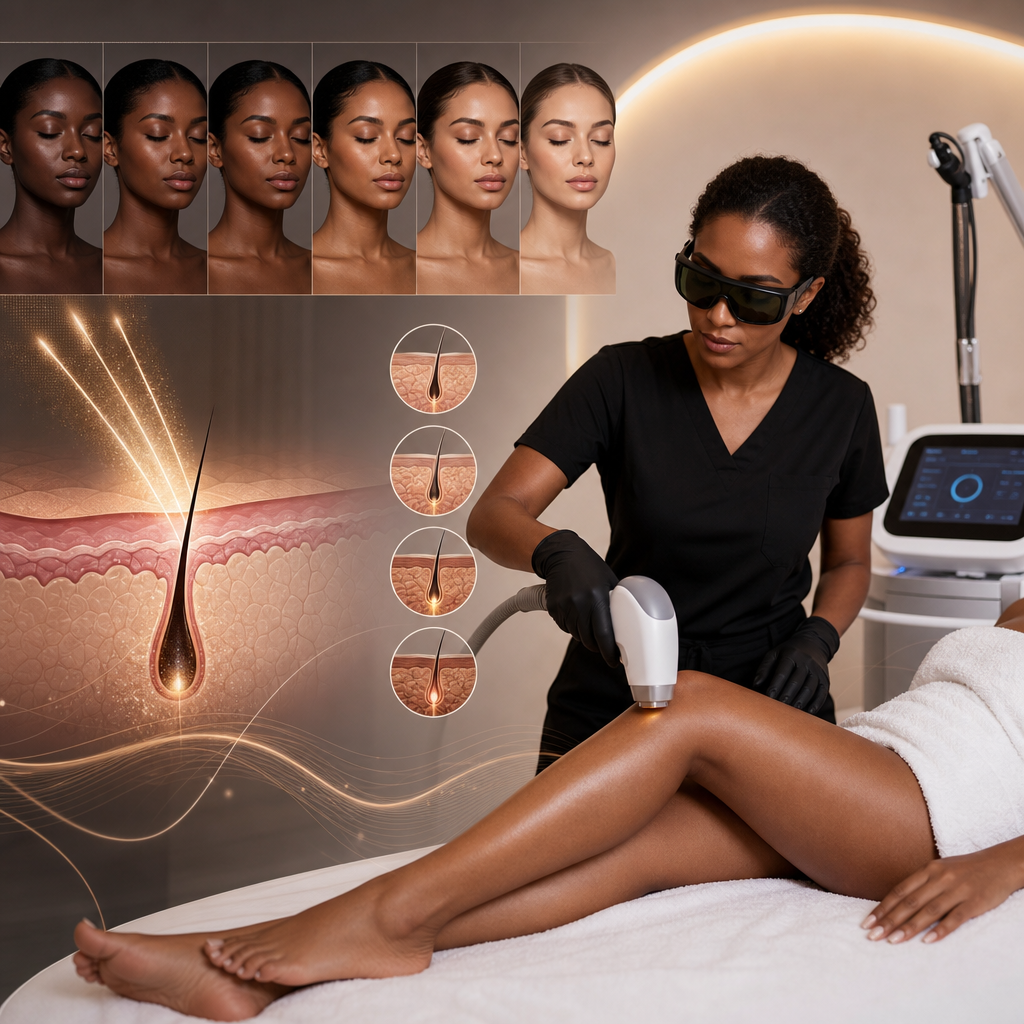
For darker skin, longer wavelengths (808-1064 nm) excel because they penetrate deeply while being less avidly absorbed by superficial melanin. Extended pulse durations prevent rapid epidermal heating. Real-time cooling protects the surface while follicular destruction occurs beneath.
Modern understanding of ethnic dermatology has transformed laser treatment from a risky proposition on dark skin to a safe, predictable procedure when executed by knowledgeable clinicians with appropriate technology. The science is established. The outcomes are documented. Dark skin deserves equally effective hair removal as any other skin type.
Action step: Schedule your consultation at Éternité Medical Aesthetics & Longevity Centers today. Laser hair removal tailored to your skin type awaits.
Contact Us Today For A Free Consultation
Frequently Asked Questions (FAQ)
Is laser hair removal safe for my dark skin tone?
Yes, we use specialized laser systems specifically calibrated for melanated skin. Our technology selects wavelengths that target hair pigment while safely bypassing the melanin in your skin, minimizing the risk of burns or discoloration that can occur with standard lasers. We assess your Fitzpatrick skin type during your consultation to customize the exact settings we use for your treatment.
What makes your approach different from other laser hair removal clinics?
We invest in advanced laser platforms designed with dark skin safety as a primary feature, not an afterthought. Our practitioners receive specialized training in treating diverse skin tones, and we adjust parameters like pulse duration and fluence individually for each client rather than using one-size-fits-all settings that put melanated skin at risk.
How many sessions will I need to see permanent results?
We typically recommend six to eight sessions spaced four to six weeks apart for optimal hair reduction on darker skin types. The exact number depends on your hair thickness, density, and growth cycle, which we evaluate during your initial consultation to give you a personalized treatment timeline.